


 English
 中文简体
中文简体 Español
When Does a Disposable Surgical Flat Mask Stop Working and Need to Be Replaced?
Content
- 1 The Standard Effective Duration of a Disposable Surgical Flat Mask
- 2 How a Surgical Flat Mask Works and Why Duration Matters
- 3 Factors That Shorten the Effective Lifespan of a Surgical Mask
- 4 Signs That a Disposable Surgical Flat Mask Must Be Replaced Immediately
- 5 Surgical Flat Mask Duration Across Different Use Environments
- 6 Why You Should Never Reuse a Disposable Surgical Flat Mask
- 7 Proper Disposal and Replacement Protocol
- 8 Choosing a High-Quality Disposable Surgical Flat Mask
The Standard Effective Duration of a Disposable Surgical Flat Mask
The most widely accepted guideline from health authorities and mask manufacturers is that a disposable surgical flat mask remains effective for a maximum of four hours of continuous use. This figure is not arbitrary — it is based on clinical research and practical testing that measures how filtration efficiency, breathability, and structural integrity degrade over time during real-world use. After four hours, the mask's ability to filter airborne particles and prevent the transmission of droplets diminishes to a level that can no longer be considered reliable protection.
It is important to understand that this four-hour window applies to conditions of normal, continuous wear in a standard environment. In clinical or surgical settings where the wearer is speaking frequently, working in a humid operating room, or exposed to heavy splatter, the effective duration may be considerably shorter. Healthcare institutions typically replace surgical masks every one to two hours during intensive procedures precisely because they recognize how rapidly performance degrades under demanding conditions.
How a Surgical Flat Mask Works and Why Duration Matters
A disposable surgical flat mask is constructed from multiple layers of non-woven polypropylene material. The outer layer repels fluids and large droplets. The middle layer — often a melt-blown fabric — acts as the primary filtration barrier, capturing fine particles through a combination of mechanical interception and electrostatic charge. The inner layer sits against the face and is designed for comfort and moisture absorption.
The electrostatic charge within the melt-blown layer is particularly critical to the mask's performance. This charge actively attracts and traps fine particles that would otherwise pass through based on size alone. However, this charge degrades over time, especially when the mask becomes moist from exhaled breath. Once the electrostatic charge dissipates — which begins to happen progressively from the moment the mask is put on — filtration efficiency drops. This is the primary reason why time limits exist and why a visually intact mask can still be functionally compromised.
Factors That Shorten the Effective Lifespan of a Surgical Mask
While four hours is the standard benchmark, several real-world factors can reduce effective protection well before that point. Understanding these variables helps wearers make better decisions about when to replace their mask, rather than relying on the clock alone.
Moisture and Humidity
Exhaled breath contains water vapor, and over time this moisture saturates the inner and middle layers of the mask. A damp mask loses structural integrity and filtration efficiency simultaneously. The melt-blown layer's electrostatic charge collapses faster in the presence of moisture, and a wet mask may also allow bacteria to proliferate on its surface. In high-humidity environments or during physical exertion that increases breathing rate, the mask can become noticeably damp in as little as 30 to 60 minutes, at which point it should be replaced immediately.
Frequent Talking and Heavy Breathing
Speaking generates significantly more expelled moisture than quiet breathing. Healthcare workers, teachers, and others who talk continuously throughout their work shift will find their mask degrades much faster than someone working quietly. Similarly, physical activity that elevates breathing rate increases the volume of moist air passing through the mask per unit of time, accelerating both moisture saturation and mechanical stress on the filtration layers.
Touching, Adjusting, and Improper Handling
Every time a wearer touches the front surface of a surgical mask, they risk transferring contaminants from their hands onto the filtration layer, and potentially pushing particles through the mask structure. Repeatedly pulling the mask down to the chin and back up — a common habit — contaminates the inner surface with whatever is on the chin and neck, while also distorting the shape and compromising the facial seal. Even a single instance of touching the mask with unwashed hands can functionally defeat its protective purpose regardless of how much time is left on the four-hour window.
Exposure to Contaminants or Splatter
In medical, laboratory, or food processing environments, the outer surface of the mask may become directly contaminated with biological material, chemicals, or particulates. Any visible contamination of the mask's exterior — including blood, secretions, or heavy dust — is an immediate signal to discard and replace the mask, regardless of how recently it was put on. Continuing to wear a visibly contaminated mask defeats the purpose of wearing one entirely.
Signs That a Disposable Surgical Flat Mask Must Be Replaced Immediately
Beyond the time-based guideline, there are specific physical indicators that clearly signal a mask has reached the end of its effective life. Any one of the following conditions warrants immediate disposal and replacement:
- The mask feels damp or noticeably moist against the face, indicating the inner and middle layers have absorbed sufficient moisture to compromise filtration performance.
- Breathing through the mask has become significantly easier than when first worn, which may indicate the filtration layer has been compromised or deformed.
- The mask no longer sits flush against the face — gaps around the nose, cheeks, or chin allow unfiltered air to bypass the mask entirely.
- Visible staining, discoloration, or contamination is present on either the outer or inner surface of the mask.
- The ear loops or ties have stretched, broken, or otherwise failed to hold the mask securely in position against the face.
- The mask has been removed and set down on a surface, then picked up again — this cross-contamination risk makes the mask unsafe to reuse.
- The nose wire has been deformed to the point where it can no longer be reshaped to provide a close seal around the bridge of the nose.
Surgical Flat Mask Duration Across Different Use Environments
The appropriate replacement schedule for a disposable surgical flat mask varies depending on the setting in which it is used. What is acceptable in a low-risk public environment may be wholly insufficient in a clinical or industrial setting.
| Use Environment | Recommended Maximum Duration | Key Risk Factor |
| General public / commuting | Up to 4 hours | Moisture from breathing |
| Office or classroom setting | 2–4 hours depending on talking | Frequent speech increases moisture |
| Clinical / hospital ward | 1–2 hours or per procedure | High contamination and humidity risk |
| Surgical / operating room | Per procedure or 1 hour max | Splatter, humidity, extended wear |
| Industrial / dusty environment | 1–2 hours or when visibly soiled | Particulate loading clogs filtration layer |
| Outdoor use / exercise | Under 2 hours due to sweat | Physical exertion saturates mask rapidly |
Why You Should Never Reuse a Disposable Surgical Flat Mask
The word "disposable" in the product name is not a suggestion — it is a fundamental aspect of how the mask is designed and validated. Disposable surgical flat masks are engineered for single-use only, and attempting to extend their life through reuse introduces risks that outweigh any perceived convenience or cost savings.
When a used mask is removed and stored — whether folded into a pocket, left on a desk, or placed in a bag — the inner surface, which has been in direct contact with the wearer's mouth and nose, is exposed to environmental contaminants. When the mask is put back on, those contaminants are re-introduced directly into the breathing zone. Additionally, the act of removing and re-applying the mask invariably involves touching the filtration surface, transferring hand contamination onto the very layer meant to provide protection.
Attempts to sanitize or extend the life of a disposable surgical mask — such as spraying with disinfectant, microwaving, or air-drying — damage the filtration structure and destroy the electrostatic charge in the melt-blown layer without restoring the mask to a safe or functional condition. Research has consistently shown that these methods degrade mask performance rather than restore it. The only responsible approach is to dispose of the used mask safely and use a fresh one.
Proper Disposal and Replacement Protocol
Disposing of a used surgical mask correctly is as important as wearing one correctly. An improperly discarded mask can become a source of contamination for others, particularly in healthcare or high-risk settings. Follow these steps to remove and dispose of a used disposable surgical flat mask safely:
- Before removing the mask, clean your hands thoroughly with soap and water or an alcohol-based hand sanitizer of at least 60% concentration.
- Remove the mask by touching only the ear loops or ties — never touch the front filtration surface of the mask during removal.
- Place the used mask directly into a closed waste bin. In clinical settings, use the designated clinical waste stream as required by local regulations.
- Clean your hands again immediately after disposal before touching your face or any other surface.
- Apply a fresh mask immediately if continued protection is required, ensuring the nose wire is shaped to your face and the mask covers both nose and chin fully.
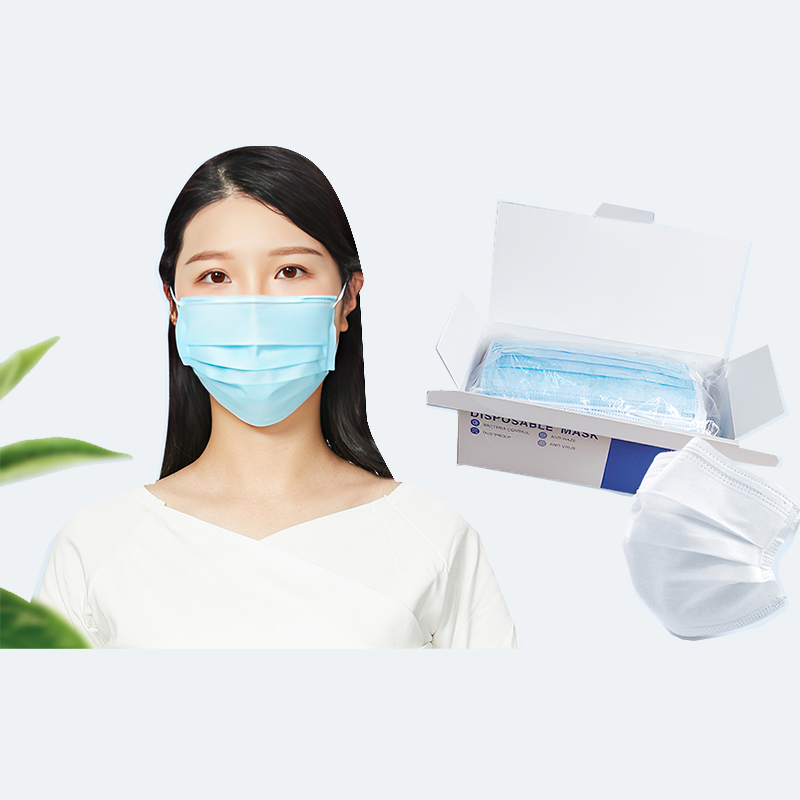
Choosing a High-Quality Disposable Surgical Flat Mask
Not all disposable surgical flat masks offer the same level of protection or the same baseline effective duration. Masks that meet recognized regulatory standards — such as ASTM F2100 in the United States, EN 14683 in Europe, or YY 0469 in China — have been tested for bacterial filtration efficiency (BFE), fluid resistance, breathability, and flammability. A mask rated at BFE ≥98% under ASTM or EN standards offers a meaningful level of filtration at the start of its use period.
When purchasing surgical flat masks, look for clear labeling that identifies the applicable standard and filtration rating, and avoid uncertified products that may look identical but lack the tested filtration layers. The flat design — as opposed to a molded cup or duckbill shape — should still provide sufficient facial coverage and be paired with a pliable metal or aluminum nose wire that can be shaped precisely to prevent air gaps at the bridge of the nose. A well-fitted, certified mask used for no more than four hours and replaced at any sign of moisture or damage is the most effective approach to getting full value from every mask you use.
Recommended Products
-

Cashmere handfeel Dark Green Wool Sweater
-

Orange Loose Neck Pullover Sweater
-

Romantic Purple Cardigan
-

Fur Lapel Lace-up Cardigan
-

Cut Out Knitted Tank Top
-

V-Neck Knitted Tank Top
-

Swing Sweater Dress With Nipped Waist
-

Stylish Asymmetrical Knit Long Dress
-

Gradient Color Side Split Half-Length Skirt
-

Black A-line Skirt
-

Thin Ice Silk Slimming Leggings
-

Draped Striped Loose Pants


-

Tel: +86-13913661100
-

Email: frank@sofiafashion.com
-

Add: No.886, Minfeng Road, Xushi Street, Dongbang Town, Changshu, Jiangsu, China
© 2023 Sofia Group. All rights reserved Design Custom Women's Knitted Sweaters Manufacturers
